AI Isn’t Delivering Results? Here’s What Your Business Might Be Missing
How to integrate AI in business is one of the most common challenges organisations face today. While many companies invest heavily in AI tools and automation, the real difficulty lies in embedding AI into existing systems, workflows, and decision-making processes.
Across industries, organisations are investing in AI-powered tools, automation platforms, and large language models with the expectation of immediate results. Chatbots, copilots, and generative AI solutions are being deployed at pace.
Yet despite this surge in adoption, a consistent pattern is emerging.
Many AI initiatives are not delivering meaningful business outcomes.
This is not due to a limitation in the technology. Research consistently shows that the majority of AI projects fail to deliver value not because of the models themselves, but because of how they are implemented, integrated, and governed within the organisation.
The Expectation Gap: What Businesses Think AI Does
A common misconception is that AI can be introduced into a business with minimal effort and begin delivering immediate value.
This often leads to expectations such as:
- AI can be “plugged in” to existing systems
- It requires minimal configuration
- It can instantly replace manual effort
- It will continuously generate insights without intervention
In reality, these assumptions create a disconnect between expectation and outcome.
AI does not operate effectively as a standalone tool. When deployed without the right foundations, it often remains isolated, under-utilised, or unreliable.
Why Most AI Projects Fail to Deliver Value
The underlying reasons for failure are well documented across enterprise environments.
Poor data quality remains one of the most significant barriers, with inconsistent or fragmented data leading to unreliable outputs and reduced trust in AI systems.
Lack of integration is another critical issue. When AI systems are not connected to core business platforms, they cannot influence real workflows or decision-making processes.
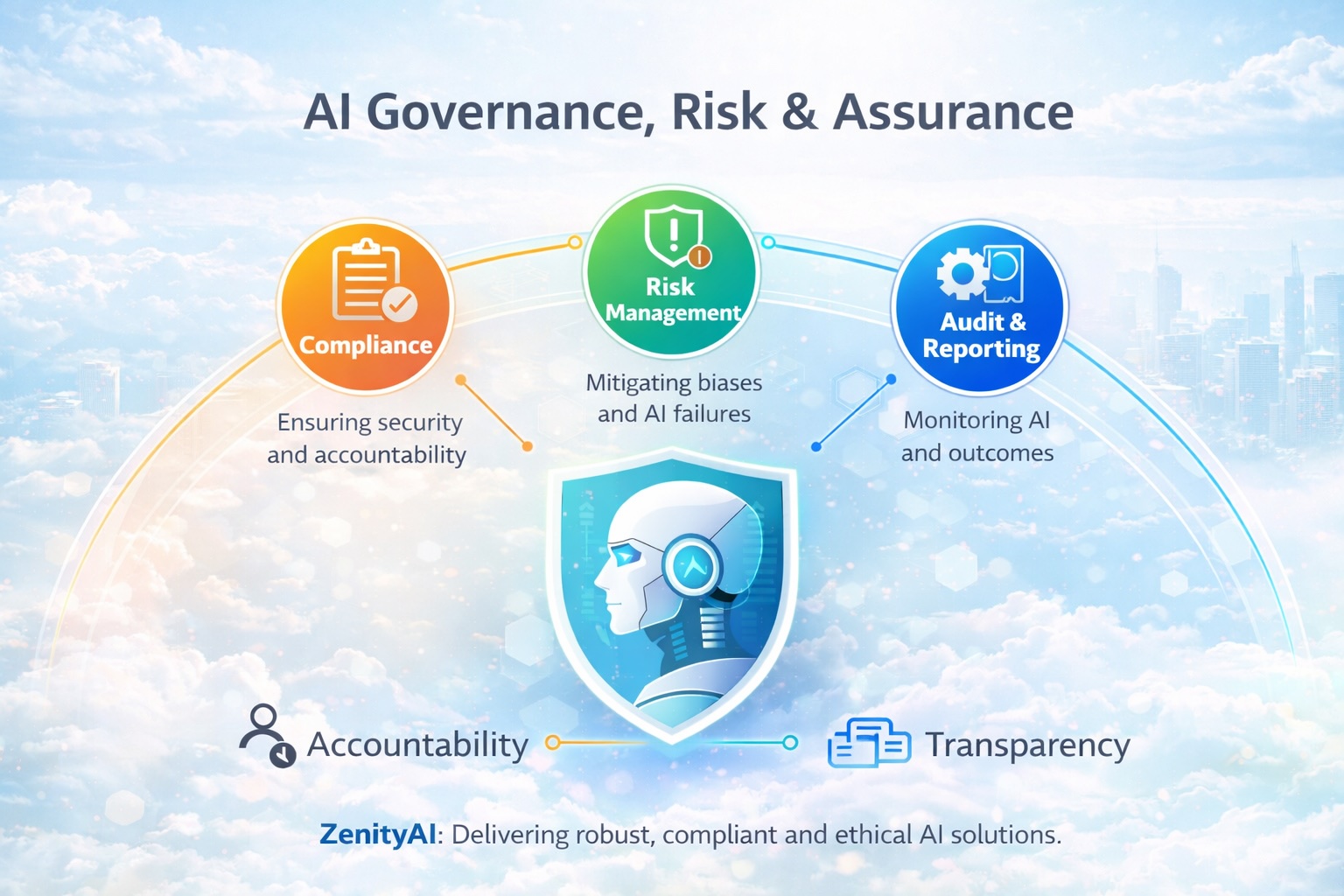
Governance gaps also contribute to failure, with many organisations lacking clear frameworks for risk, compliance, and responsible AI usage.
In addition, weak adoption strategies and limited change management often result in low usage, even when the underlying solution is technically sound.
These challenges reinforce a simple reality.
AI does not fail because of AI.
It fails because the surrounding systems are not designed to support it.
What Actually Drives AI Outcomes in Business
For AI to deliver measurable value, it must be embedded into the operational and technical fabric of the organisation.
1. Data Structuring and Cleaning
AI systems are entirely dependent on the quality of the data they consume. Disorganised, incomplete, or siloed data directly impacts model performance and output reliability.
Organisations that invest in structured, well-governed data environments are far more likely to achieve consistent and scalable AI outcomes.
2. Workflow Integration (Not Just Tools)
One of the biggest gaps in AI implementation is the disconnect between AI tools and business workflows.
AI that sits outside operational processes — such as CRM updates, service workflows, or decision pipelines — remains a passive tool rather than an active driver of value.
3. Model Tuning and Context Grounding
Out-of-the-box models are designed for general use, not specific business contexts.
Without tuning and contextual grounding, outputs can be generic, inconsistent, or misaligned with organisational needs.
Effective AI implementations align models with domain-specific data, terminology, and decision frameworks.
4. Guardrails and Governance
As AI becomes more embedded in business processes, governance becomes critical.
Without clear guardrails, organisations face risks related to compliance, data privacy, and decision accuracy. Poor governance can also lead to inconsistent outputs and reduced trust in AI systems.
Embedding governance early ensures that AI operates reliably and responsibly at scale.
5. Continuous Monitoring and Iteration
AI is not a one-time implementation.
Models require continuous monitoring, evaluation, and refinement to maintain performance over time. Business environments change, data evolves, and user behaviour shifts — all of which impact AI effectiveness.
Organisations that treat AI as an evolving capability, rather than a static deployment, achieve significantly better outcomes.
6. Embedding AI into Business Workflows
Beyond integration, AI must become part of how work is actually done.
This includes enabling AI-driven decision-making, automating repeatable processes, and augmenting human workflows rather than replacing them entirely.
When AI is embedded into daily operations, adoption increases and value becomes measurable.
7. API Integrations with Existing Systems
AI does not operate in isolation.
It needs to connect seamlessly with existing systems such as CRM platforms, ERP systems, data warehouses, and operational tools.
Without these integrations, AI remains disconnected from the data and processes that drive the business.
8. Change Management and Adoption
Technology alone does not drive transformation.
Successful AI implementation depends heavily on people — how they understand, trust, and use the system.
Organisations that invest in training, communication, and adoption strategies are far more likely to move beyond pilot stages and achieve real impact.
From AI Hype to Business Impact
There is a clear pattern across industries.
Organisations that treat AI as a tool tend to struggle.
Organisations that treat AI as a system tend to succeed.
The difference lies in execution.
AI delivers value when it is aligned with business processes, supported by strong data foundations, integrated into existing systems, and governed effectively.
This shift — from isolated tools to integrated systems — is what separates AI experimentation from AI-driven transformation.
How ZenityAI Supports AI Implementation and Integration
At ZenityAI, we help organisations move beyond AI experimentation and into structured, outcome-driven implementation.
Our services include:
- AI Readiness & Data Assessment
- Data Structuring, Cleaning & Preparation
- Workflow Design & AI Integration Strategy
- Model Tuning & Context Grounding
- API & System Integration (CRM, ERP, internal platforms)
- AI Governance, Risk & Compliance Frameworks
- Monitoring, Optimisation & Continuous Improvement
We work with both private enterprises and government organisations to ensure AI systems are:
- Practical
- Scalable
- Secure
- Compliant
- Reliable
We help organisations implement:
✔ Structured, AI-ready data environments.
✔ AI embedded within real business workflows.
✔ Integrated systems connected through secure APIs.
✔ Governance frameworks with clear guardrails.
✔ Continuous monitoring and optimisation models.
✔ Adoption strategies that drive real usage
AI should deliver measurable business outcomes — not remain a proof of concept.
AI should integrate into how your business operates — not sit outside it.
Making AI Work in Your Business
The organisations seeing real results from AI are not simply adopting tools.
They are building the right foundations around them.
AI delivers value when it is supported by structured data, integrated into business workflows, aligned with existing systems, and continuously optimised over time.
Without this, even the most advanced AI solutions remain under-utilised.
At ZenityAI, we work with organisations to move beyond fragmented AI initiatives and into practical, scalable implementation. Our focus is on embedding AI into real business environments — where it can drive measurable outcomes, improve efficiency, and support better decision-making.
To discuss how ZenityAI can support your AI implementation and integration strategy, contact our team for a confidential consultation.